
In recent years, headlines have painted a grim picture of the impact of bottom trawling and dredging on the ocean’s carbon cycle.
Articles in major outlets such as the Guardian and the National Geographic have pointed to alarming findings that bottom-towed fishing gears disturb seabed sediments, releasing vast quantities of stored organic carbon into the water column – carbon that is then converted (remineralised) into CO2 and released into the atmosphere, fuelling climate change.
These concerns are grounded in credible science, but increasingly, experts are warning that some of this evidence is being misunderstood or misused, which could be misleading for the public and politicians.
Much of the research behind these claims has focused on fishing over areas of muddy sediment, which are known to store higher levels of organic carbon. However, the results from these specific environments have often been extrapolated to represent the impact of bottom-towed fishing across all seabed types and all fleets, regardless of gear, effort or fishing grounds.
In reality, many of the key British fishing grounds, particularly around the South West, are characterised by coarse or rocky sediment which is known to store lower levels of organic carbon.
Now, a new study by Bangor University and partners looks set to bring some much-needed nuance to this conversation. Funded by Defra through the Fisheries Industry Science Partnerships (FISP) scheme, the study investigated the impact of beam trawling and scallop dredging on the release of carbon stored in the seabed – otherwise known as blue carbon.
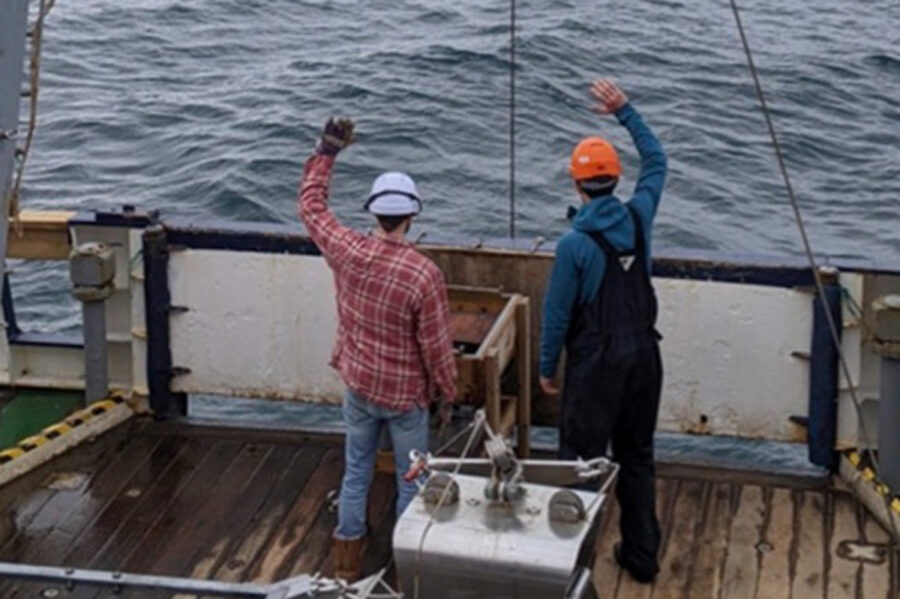
The project was a collaboration between Bangor University, Imperial College London, Cefas, the Western Fish Producers’ Organisation (WFPO) and the South Western Fish Producer Organisation (SWFPO). It involved the use of Bangor’s research vessel Prince Madog, which conducted sediment and water sampling before and after fishing – conducted by the beam trawler Monty of Ladram, participating on behalf of the WFPO, and the scalloper Golden Promise, provided by the SWFPO. For the study, these vessels towed in an area that had been unfished for the preceding three months, providing a controlled setting.
Unlike the high-carbon muddy seabeds featured in many studies, the predominantly coarse-sediment seabed fished during this research project contained naturally low levels of organic carbon to begin with. Dr Tim Whitton, one of the lead researchers at Bangor, explained: “Low amounts of organic carbon were found in the coarse sediments we studied at the depths reached by the fishing gear (around 5.5cm for scallop dredges), even before fishing occurred.
“Our experiment results did not show clear evidence of seabed fishing removing organic carbon from the sediment or increasing remineralisation during or after fishing. However, longer-term studies are needed to build a more complete picture.”

An example of the sediment sampled, which was predominately sandy gravel across the study area and region.
This adds weight to what many in the industry have long argued: the impact of bottom trawling on seabed carbon varies significantly depending on where and how it is done. “The public narrative seems to assume that all trawling releases huge volumes of CO2 into the atmosphere,” said Juliette Hatchman, CEO of the SWFPO.
“But this research exposes just how misleading such generalisations can be, particularly as the majority of our bottom-trawling activity occurs on coarse sediment, where the impact on blue
carbon release appears to have been considerably overstated. Management approaches informed by current assumptions are likely to significantly inflate the impact of fishing.”
Professor Jan Hiddink, who led the research, echoed the need for a more evidence-based approach. “We currently do not know enough about the impact of trawling on seabed carbon to make robust large- scale projections. This project has helped fill a knowledge gap around coarser sediments.
“Future work must evaluate both short- and long-term impacts of different gear types in different environments before we can say where and when trawling may release carbon.”
As our understanding of ocean carbon dynamics continues to evolve, the interaction between fishing activity and blue carbon storage will likely remain a critical area of study, especially given the role oceans play in regulating global CO2. However, this study highlights the danger of relying on incomplete data to make sweeping policy decisions.
The findings provide a timely reminder that not all bottom fishing is equal, and that science-led management must reflect the realities of specific fisheries, not generalised assumptions.
As public and political focus on blue carbon intensifies, it’s essential that decision-makers are equipped with robust, real-world data on the role of fisheries. Seabed carbon dynamics are complex, and our response must be equally informed. Broad-brush claims may grab headlines, but evidence-based and site-specific science should shape the future of marine policy.
The full results of the study are available here and will be published in an upcoming peer-reviewed journal.
By Harry Owen
This story was taken from the latest issue of Fishing News. For more up-to-date and in-depth reports on the UK and Irish commercial fishing sector, subscribe to Fishing News here or buy the latest single issue for just £3.50 here.
Sign up for Fishing News’ FREE e-newsletter here.